

Shorelight Shorelight Built for Regent Seven Seas
Hawkes & Kwortnik · Built for Regent Seven Seas

Every guest,
remembered
every voyage.

Regent's returning guests expect to be known. Most of what your line has learned about them — the suite they prefer, the wine they love, the reason they keep coming back — isn't anywhere the crew can reach. Staff rotate, the PMS doesn't carry preferences, and the observation a butler made last voyage leaves the ship when they do. Shorelight fixes this: it keeps the memory of every guest where it belongs, in the hands of whoever serves them next, before the guest steps aboard.

Scroll
One system · three doors
Why It Matters

A Regent guest relationship is worth hundreds of thousands of dollars over a lifetime. Very little of what you've learned about them survives the next crew rotation.

Guest equity is the total future value a relationship represents: return voyages, suite upgrades, referrals, and advocacy. It compounds with each return — and erodes every time a returning guest goes unrecognized.

15–25%

Revenue lift McKinsey documents for personalization leaders in luxury and travel. In all-inclusive cruising, where base price is fixed, the lift flows almost entirely to rebooking rates and advocacy — the durable assets a memory system builds.

7th

A Seven Seas Society member on their seventh voyage. Two crew rotations since their last sailing. No one aboard knows their history with the line. Not a lapse in care — a lapse in memory.

$0

The recorded value of everything your people know about your guests on the day they rotate, transfer, or leave the line.

The problem is not a missing CRM or a training gap. It is the distance between what the line knows about a guest and what the crew can act on while that guest is standing in front of them. The seventh voyage feels like the first because people rotate, the PMS does not remember, and the note from the call center never reaches the dining room.

Most lines treat this as a training problem. It is a memory problem. Give the crew the right context and they carry the moment: at the front desk, in the dining room, at the shore-excursion desk. What they cannot do is conjure context they were never given.

How It Works

Clear enough to act on, restrained enough to feel like Regent.

{{ step.n }}
{{ step.title }}

{{ step.body }}

What "public signal" actually means

Shorelight starts from what guests have already shared with the world: their own online activity, public by their own choice. If a guest meant to keep something private, it never enters the system.

{{ s.label }}

{{ s.body }}

Everything Shorelight reads, the guest put into the world themselves. It reads that signal, suggests one moment, and stops. Nothing comes from a data broker; nothing is inferred behind a guest's back. A gesture that announces its source stops being a gesture, so Shorelight is built to know when not to speak.

It Starts With Zero Integration

Shorelight begins without an IT project and earns its way deeper.

{{ i.step }}

{{ i.lead }} {{ i.body }}

Why This Was Built for Regent

{{ w.lead }} {{ w.body }}

Why Now
{{ n.title }}

{{ n.body }}

The Demonstration

See it live with Regent guest profiles — every claim labeled by source.

Every profile is source-banded: public fact, owner-provided context, operational inference, or demonstration assumption. Nothing private is asserted as fact.

Seven Seas Grandeur · Iberian Indulgence · illustrative sailing

Every guest on this sailing, ranked by lifetime value.

Guest equity is the long-term revenue each passenger represents—return sailings, suite upgrades, referrals, onboard spend—not just what they paid today. This view shows that number for everyone aboard, how much of it is at stake on this voyage, and the two or three service moments most likely to move it.

Total guest equity
$420K–$775K
Influenceable upside
$191K–$330K
Highest leverage
Embarkation → Day 2
Equity levers
Financial · Influence · Co-Creation · Loyalty
Fleet equity · portfolio view
~4,500
Seven Seas Society members
Active across the fleet. Top 15% account for an estimated 55–65% of fleet loyalty value.
~340
Quietly lapsing
Society members gone silent 18+ months. Estimated equity at risk: $35M–$65M. No outreach in progress.
Lane B
Shoreside pilot · 50 lapsed guests
One desk, one quarter. Measures contact-to-rebook on the quietest slice. No Hotel Ops required.

Fleet equity figures are modeled estimates based on ~4,500 Seven Seas Society enrollment and published loyalty-program participation patterns in luxury cruising. Regent can calibrate against its own member count, lapse-rate, and LTV data.

Sort
Equity to protect Influenceable upside
{{ m.initials }}
{{ m.lens }}

{{ m.name }}

{{ m.role }}
{{ m.suite }}
Guest equity value

{{ m.read }}

{{ m.influence }} · can influence
{{ m.liftLabel }}

{{ m.liftNote }}

Moments that move the number
{{ mo.n }}

{{ mo.t }}

Why this view

Every name is a guest the crew can recognize before embarkation.

The value to protect, the upside still in reach, and the few moments that move it, for each guest, opened the way a butler would read it.

{{ equityModal.lens }}

{{ equityModal.name }}

Guest equity, decomposed on the Guest Equity Index
{{ equityModal.totalLabel }}
Composition (midpoint share)
{{ d.label }} {{ d.sub }}
{{ d.rangeLabel }}

{{ d.driver }}

Method. Guest equity is the discounted value of the relationship across the four dimensions of the Guest Equity Index (Hawkes & Kwortnik, Guest Equity Architecture). Financial value is net of acquisition, distribution and cost-to-serve. Figures are modeled sensitivity bands shown to demonstrate the architecture, to be calibrated against Regent booking, loyalty and sailing data in the pilot.

Live Seven Seas Grandeur · Iberian Indulgence · illustrative sailing
Butler Reyes · on shift{{ activeSuiteLine }}
{{ activeGuest.initials }}
Public profile
{{ activeGuest.lens }}

{{ activeGuest.name }}

{{ activeGuest.role }} · {{ activeGuest.loc }}
{{ activeGuest.score }}
{{ activeGuest.scoreLabel }}
Public source Briefing context Observed signal Inference, labeled Private data excluded

Source basis. {{ activeGuest.sourceBasis }}

The read · guest intelligence Shorelight AI
{{ r.h }}

{{ r.b }}

Preferences & Patterns
{{ p.label }}

{{ p.body }}

Moments That Matter

Of everything the crew could do, the few moments with the highest value against what this guest actually cares about.

{{ consideredCount }}
considered
{{ surfacedCount }}
surface

The restraint is the point. The {{ restCount }} set aside (generic amenity drops, scripted welcomes, standard turndown gifts) were considered, then deliberately kept out of the way.

{{ m.rank }}
{{ m.title }}
{{ m.pct }}

{{ m.why }}

{{ lev }} Confidence: {{ m.conf }} · Source: {{ m.source }}
Crew Conversation Prompts
{{ pr.when }}

{{ pr.text }}

{{ su.label }}

{{ su.body }}

Crew Insights

Something you noticed about this guest that the next crew member should know. Added to the living profile: the kind of small observation that survives a rotation.

{{ ci.n }}

{{ ci.text }}

Crew note · {{ ci.when }}
Shoreside · Direct Sales & Loyalty

The desk that reaches the guest who has gone quiet.

A loyal guest who has not booked in a while is not a cold record. Shorelight hands the shoreside team the whole relationship, the likely reason the guest drifted, and the one specific reason to call — so the outreach lands as recognition, not a sales script. The same guest equity that runs onboard, pointed at the guests who are quietly slipping away.

Two ways in

The same guest equity reaches the guest two ways — before they sail, and while they are aboard.

Shoreside works the guest who has drifted; the crew works the guest who is here. Neither waits on the other, and both read from one profile.

Guest-direct · shoreside re-engagement
Reach the guest who has drifted.

A loyalty specialist opens a brief per guest: the history, the likely reason for the silence, and the single personal reason to make contact — so the call arrives as a line worth remembering, before a competitor fills the silence.

Crew-introduction · onboard recognition
Meet the guest who is here.

When that same guest sails again, the crew are handed the standing they earned — recognized at the front desk and the dining room by people who have never met them, because the profile carried across the rotation.

One desk · one quarter

A Seven Seas Society member — six voyages, then eighteen months of silence.

On a spend report she is a lapsed number. In Shorelight she is a relationship the line already earned: the excursions she loved, the suite she asked for twice, the quiet note that she stopped sailing the season her husband did. The brief does not say call her. It says here is the one thing worth saying.

Fifty of these guests, worked from a Shorelight brief for one quarter, become a clean measure: contact-to-rebook against a matched control. The shoreside lane needs nothing from Hotel Ops to start — it produces a documented result on its own, and the detail is in the Pilot Plan.

The Pilot

One ship — Seven Seas Prestige. One season. Essentially nothing from IT.

A contained, measurable test a new-in-role president can stand behind, with a kill rule agreed up front — if the pilot does not clear the bar, you stop and keep the work — and a clean null that counts. Here is how every number on the platform is graded, what the pilot proves, and where the line sits on what we never touch.

Investment $45,000 · one ship, one season, no enterprise commitment required.
The kill rule

If repeat-booking intent and NPS-per-voyage do not each lift above the matched-control baseline at 60 days, the pilot closes. We publish the null, hand Regent the data, and move on. A clean stop is part of the product.

Two Entry Points

One pilot, two lanes — each can proceed without the other.

The onboard lane runs through Hotel Ops. The shoreside lane runs through Loyalty Sales and needs nothing from Hotel Ops to start. Either produces a measurable before/after. Both running together means neither waits on the other.

Lane A · Onboard
One ship. One season.

Butler briefs, crew adoption, and rotation metrics on Seven Seas Prestige. Measures whether service recognition lifts rebooking intent and NPS vs. a matched-control sailing. Requires Hotel Ops buy-in and crew onboarding.

Stakeholder: Hotel Operations · timeline: one sailing season
Lane B · Shoreside
One desk. One quarter.

Fifty lapsed Seven Seas Society members — gone quiet for 18+ months. One outreach specialist working from a Shorelight brief per guest. Measure contact-to-rebook rate against the cold-outreach baseline. Zero IT dependencies. Zero Hotel Ops involvement. The result lands in one quarter.

Stakeholder: Shoreside Sales & Loyalty · timeline: one quarter

Either lane produces a documented result. If Hotel Ops is slow to move, the shoreside result exists independently. If the shoreside outreach lands first, the onboard lane is already resourced.

The Guest Equity Index

Four dimensions, not one spend number.

Shorelight measures guests on the Guest Equity Index from Hawkes & Kwortnik's Guest Equity Architecture: the four dimensions that predict long-term portfolio value, not a single spend metric. A personalized moment costs almost nothing; the all-inclusive infrastructure is already in place. The risk runs the other way: a missed moment is a perishable loss the guest never mentions.

{{ fw.k }}
{{ fw.s }}

{{ fw.b }}

The stakes · why this is worth a check

~$150M of guest-relationship equity rides on a single sailing. Shorelight claims a disciplined few percent of the movable part.

The $150M is a modeled illustration of the stakes (≈744 guests × ~$200K modeled relationship value), not a revenue claim, and never value Shorelight generates. It sizes the relationship asset already in the room. Every input below is a stated, tunable assumption; Regent is invited to overwrite each one with its own LTV, churn and referral data.

# Assumption Value used Status · dial-able
{{ va.id }} {{ va.a }} {{ va.v }} {{ va.st }}
{{ vm.k }}
{{ vm.l }}
{{ vm.note }}
The defensible research spine · cited by name
{{ vs.src }}

{{ vs.claim }}

The honest frame. Even on conservative assumptions (a fraction of the documented personalization lift, applied only to the personalization-sensitive slice), Shorelight pays for itself many times over at luxury scale, with asymmetric upside if it performs closer to the McKinsey median. The big number is the stakes; the small percentage is the claim. Until the pilot replaces these inputs with Regent’s actuals, this is an honest model with visible dials, not a forecast.

Why this read is defensible

Anyone can assemble the data. The wedge is the perspective, and how every line is graded.

{{ md.n }}
{{ md.h }}

{{ md.b }}

Illustrative pilot dashboard

The measures a one-ship pilot would report.

Targets shown for shape, not as claimed results. The pilot supplies the real before/after.

{{ pm.v }}
{{ pm.l }}
{{ pm.note }}
Fleet adoption · illustrative rollout shape
{{ fa.ship }}
{{ fa.pctLabel }}
Data sourcing & the line

Only data the guest would be comfortable knowing we have.

Every source is classified Green (public), Yellow (shared with consent), or Never. The principle that governs all of it: would the guest be comfortable knowing we know this?

Data point Source Class
{{ dc.dp }} {{ dc.src }} {{ dc.cls }}
What a pilot proves

{{ pp }}

A clean null counts. If those don’t move, we say so. One ship, one season, essentially nothing required from IT.

What is not in v1

{{ nv }}

The restraint is the product. The same discipline that ranks three moments and sets aside the rest governs what the system is allowed to do at all.

Shorelight — Hawkes & Kwortnik

A line that knows its guests earns loyalty that no program can replicate.

Deploy on a single ship for one season. Guest memory survives every crew rotation — under revocable consent tiers, butler to butler, voyage to voyage. Every butler reads a 60-second brief before first interaction. The guest never feels the handoff.

Investment $45,000 · one ship, one season, no enterprise commitment required.
Shorelight — Hawkes & Kwortnik
Hawkes & Kwortnik
Hawkes & Kwortnik · The Approach

Guest equity, trust, and hospitality — with proof.

The principles behind Shorelight and the research that makes them defensible. Three pillars: guest equity as the measurable outcome, trust as the hard constraint, hospitality as the product. Each one documented, not asserted.

If you are weighing what AI will do to your guests' trust, this is written for you.

Building Trust Into the Machine

Every technology that entered hospitality was first feared as the thing that would kill it: the telephone, the keycard, online booking, the app in every guest's pocket. Handled badly, each made service colder. Handled well, each gave the crew back time to be human.

AI is the largest of these moments, and the first one powerful enough to fake the warmth it is meant to protect. That is the line Shorelight is built on: not "AI for cruise," but hospitality and trust as the architecture itself.

What We Believe
I
Hospitality is the product. Efficiency is a byproduct.

Most AI is sold as subtraction: fewer staff, faster tickets, lower cost. Ours carries the invisible load instead, the remembering and coordinating that eats a crew member's attention, so that person can look a guest in the eye. Removing the human from hospitality is a category error. We remove the friction and keep the person.

II
Recognition is the gift. It must be earned without surveillance.

The deepest luxury is to be known: your drink, your anniversary, the fact that last cruise your daughter was seasick on day two. But there is a knife-edge between "they remembered me" and "they're watching me." Shorelight is built so guests feel recognized, never surveilled. Memory serves the guest in the moment and is never turned against them. If a system cannot hold that line, it does not ship.

III
Trust is the whole foundation.

In hospitality, one broken promise costs the relationship, so we hold AI to a higher standard than ordinary software. It does not guess, and it does not invent an answer to look helpful. It says "I don't know, let me get the person who does." A confident wrong answer to a guest is worse than no answer. We would rather ship an AI that admits its limits than one that charms its way into a mistake.

IV
The human stays sovereign.

Shorelight works ahead of the moment. It senses what is coming, drafts what might help, and hands off to a person who holds the judgment and owns the relationship. The machine reports to the crew member, never the other way around. The read of a room, and every decision that matters, stays human.

V
A ship's staff is its soul.

Technology that burns out the crew to dazzle guests is a bad trade, and it shows up in the reviews six months later. Shorelight makes the hardest jobs aboard lighter: fewer systems to fight at 2am, less re-keying, more of the work they trained for. Take care of the crew and the guest experience takes care of itself.

VI
Honesty is a hard rail.

Anyone can put "trust" on a wall. We enforce it in the system: every claim traceable, every promise to a guest one the ship can keep, no dark patterns, no engineered dependency. The measure is what an audit finds, not what we say.

VII
The best help disappears.

The best service feels like a friendly ghost. Help arrives a moment before you needed it, then disappears. No screen between the guest and the sea, no chatbot demanding attention. The technology that works hardest should be the technology you notice least.

We build Shorelight this way because cruising is the last stronghold of hospitality at scale, and the cost of getting AI wrong here is higher than anywhere else. Get it wrong and you industrialize the one thing guests pay for: being treated as a person. Get it right and you give an entire ship back the time and attention to care, in person, at the exact moment it matters.

That is the whole bet: hospitality first, trust underneath, and a crew with more range, because the remembering is already done.

The proof is in the engineering

Every claim above has a mechanism behind it. A no-hallucination rail blocks confident fabrication and routes to a human instead. A complete audit trail traces any guest-facing response to its source. A human-command layer lets crew override, correct, or suppress any Shorelight output at any moment, without an IT ticket. A consent architecture separates booking data, crew observations, and cross-brand signals into independently revocable tiers.

A CTO who opens the system should find that it does exactly what this document says. No more, no less.

Shorelight.
Hawkes & Kwortnik
Hawkes & Kwortnik · Conceptual Framework

The framework behind guest equity.

Shorelight is built on a framework with two authors. Rob Kwortnik of the Cornell Nolan School brings the scholarship: more than thirty peer-reviewed publications across cruise and service science. Ethan Hawkes brings the operations: former VP Onboard Revenue at MSC Cruises — two decades running operations, stress-testing the model from the inside, voyage after voyage. The framework is published. The system has sailed.

The Conceptual Model

How the cruise experience converts into guest equity.

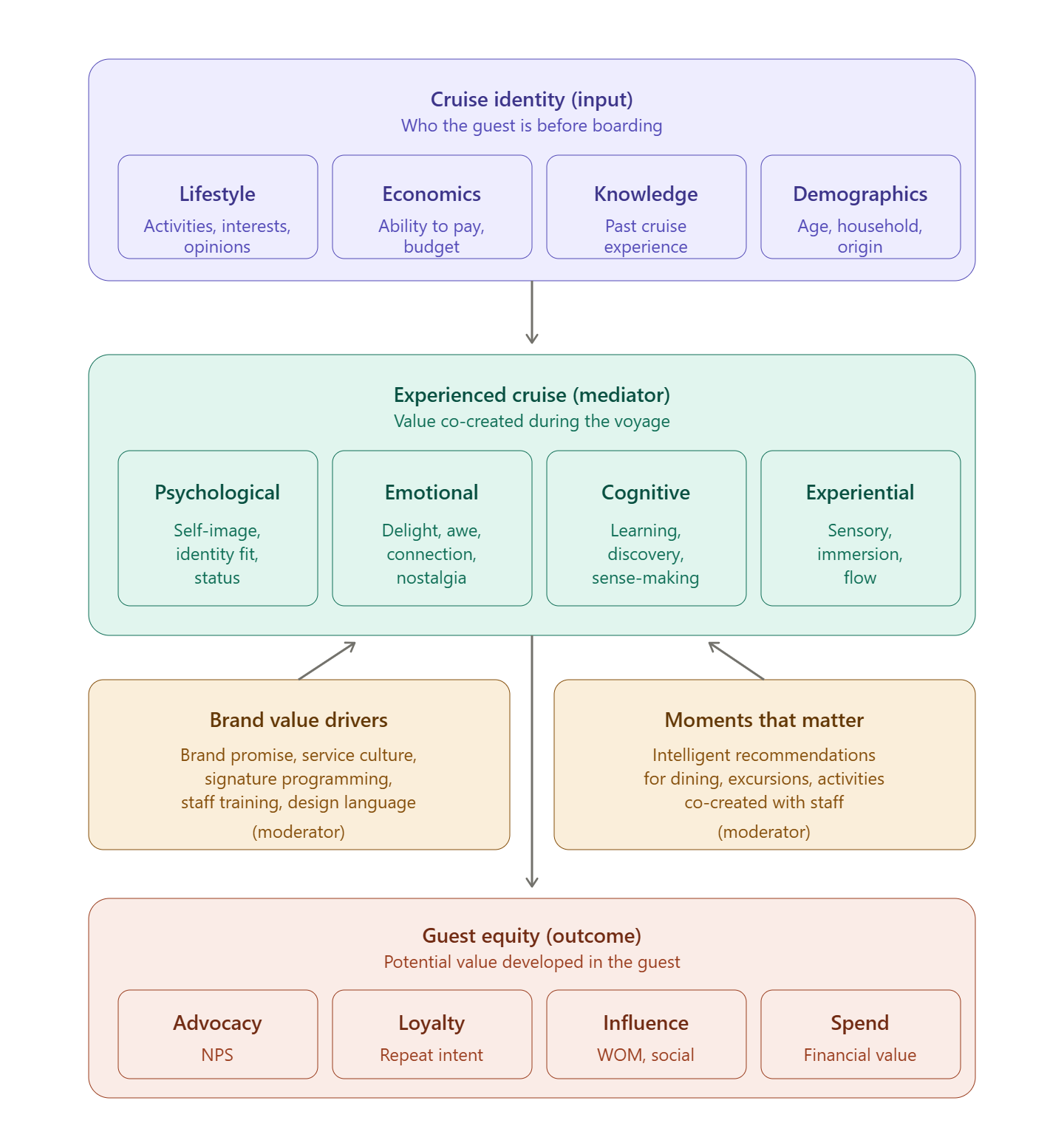
Kwortnik's model maps the causal chain from who a guest is before boarding to the relationship value the line holds after they disembark. In between sits the voyage itself, where value is co-created or quietly lost. Shorelight is that model, instrumented and running.

Kwortnik Shorelight Model: Cruise Identity → Experienced Cruise → Guest Equity
Input
Cruise identity

Lifestyle, economics, knowledge, and demographics. Who the guest is before they step aboard. Shorelight reads this from public signal before embarkation.

Mediator
Experienced cruise

The value co-created during the voyage, in the model's four dimensions: psychological, emotional, cognitive, and experiential. Shorelight's moments-that-matter engine targets each one.

Outcome
Guest equity

Advocacy (NPS), loyalty (repeat intent), influence (WOM and social), and spend (financial value). The four dimensions Shorelight measures and protects.

The moderators. Brand value drivers (brand promise, service culture, signature programming, staff training, design language) and Moments that matter (intelligent recommendations for dining, excursions, and activities, co-created with staff) sit between the cruise experience and the equity outcome. Shorelight operates on both.

The Research Anchor

Rob Kwortnik has spent twenty-five years studying why guests come back.

Kwortnik is Associate Professor of Services Marketing at the Cornell Nolan School of Hotel Administration. His research spans hedonic consumption, service recovery, guest loyalty, and tacit knowledge in service firms, the four bodies of work this framework draws on. He knows the industry firsthand.

2,850+
Google Scholar citations
Published work on hedonic consumption, service experience, and cruise loyalty.
Cornell Teacher of the Year
Creator of Cornell's Introduction to the Global Leisure Cruise Industry course.
2024
Regent Seven Seas Workshop
Rob led Regent's own brand-strategy workshop. He knows this brand from the inside.
Pillar One

Guest equity has four dimensions. Spend is only one of them.

Total onboard spend captures one moment in a relationship that can span decades and dozens of voyages. The Guest Equity Architecture replaces that single metric with the four dimensions that predict long-term portfolio value.

Financial
What the guest spends

Direct spend across revenue centers, net of acquisition and cost-to-serve. The traditional core: still essential, no longer sufficient on its own.

Influence
Who books because of them

Referrals, reviews, social reach, word of mouth. An advocate who fills two cabins per voyage may outvalue a higher spender who travels alone.

Co-Creation
How they shape the experience

Flexibility in disruption, generosity with staff, the ambient energy they bring to shared spaces. Some guests make a voyage better for everyone aboard.

Loyalty
Whether the relationship deepens

Behavioral and attitudinal commitment: program engagement, exclusivity, the arc of the relationship over successive voyages.

The flywheel. Spend drives rebooking. Rebooking builds voyage history, history enables recognition, and recognition drives advocacy, which delivers higher-value guests the line never had to acquire. Miss one moment and the loop runs in reverse: the guest walks off quietly, tells no one, and surfaces on a competitor's ship. Once the gangway comes up, the loss cannot be recovered.

Pillar Two

Recovery buys back a third of the loss. Prevention keeps all of it.

When a guest experiences a problem, satisfaction falls hard, and even a well-executed recovery restores only a fraction of the loss. Smith and Bolton documented this as the service recovery paradox. Roughly a quarter of luxury cruise guests report a problem on any given voyage. The right design target is the problem that never occurs.

−30 pts
NPS drop when a problem occurs
Consistent with Smith & Bolton's service recovery literature. The drop is disproportionate to the perceived severity of the issue.
+10 pts
NPS recovered by a well-executed service recovery
Recovery restores roughly one-third of the NPS lost. Prevention keeps the relationship intact, which makes it worth ~3× recovery.

Design implication. Shorelight is built around the signal that arrives before a problem rather than the report that follows it. The arithmetic above allows no other design.

Pillar Three

Luxury is remembered in its peaks.

Hirschman and Holbrook's work on hedonic consumption confirms what every hotelier already senses: in luxury, the defining memory is never that nothing went wrong. It is the champagne that appeared on the veranda unannounced, or the crew member who remembered an anniversary without being told. A voyage without friction is expected. The peaks get retold, and rebooked.

Prevention signals (foundational)

The guest has a dietary restriction the galley doesn't know. Their cabin temperature runs cold. Their shore excursion conflicts with an anniversary dinner.

Shorelight catches these before the gangway. Necessary, but never what the guest remembers.

Opportunity signals (differentiating)

The guest mentioned their daughter loves marine biology. A researcher is aboard. The connection gets made at dinner. They rebook before the voyage ends.

That story gets told at home, and it fills cabins at zero acquisition cost.

Design implication. Shorelight surfaces both categories, ranked by expected value against the Guest Equity Index. The record of what happened matters less than the moment still available to create.

Pillar Four

A guest who senses the system has a measurably worse experience.

Kwortnik's research carries a specific warning: luxury experiences degrade the moment guests perceive systematization. The product is the feeling of being served by someone who simply knew. Once a guest sees the machinery, that feeling is gone.

Crew are the artists

Shorelight hands them better information and leaves the rest alone. The read of the room, the judgment call, the warmth: all of it stays human.

System confidence thresholds

When Shorelight is uncertain, it withholds the signal rather than surfacing a guess. Getting the gum brand wrong is worse than never mentioning it. Below a confidence threshold: silence.

Crew can override everything

If the system recommends champagne but the crew member reads "wants quiet space," the crew member wins. No IT ticket, no manager approval. The human is sovereign, always.

Pillar Five

When a great butler rotates off, the ship forgets its best guests.

Nonaka's work on knowledge transfer in service firms names the problem hospitality lives with daily: the expertise of senior practitioners lives in them, and it leaves when they do. Every six to nine months, a luxury ship loses its sharpest intelligence about its most valuable guests. Shorelight captures that knowledge and carries it across the rotation.

Without Shorelight

A guest boards for their seventh voyage. The butler who knew them best rotated off last season. The drink order, the dinner preference, the name of the daughter who gets seasick: all of it left the ship. The guest spends the first three days re-explaining themselves.

With Shorelight

The new butler reads a sixty-second brief before first contact. The guest feels remembered from the gangway and never senses the rotation. The relationship picks up where it left off.

Primary Sources
Smith & Bolton · Service Recovery Paradox

Recovery restores only a fraction of the satisfaction lost to a service failure. Catching the moment before it becomes a complaint is worth roughly three times as much.

Hirschman & Holbrook · Hedonic Consumption

Luxury experiences are defined by peak emotional moments, not the absence of problems. Personalization that creates memorable highs drives rebooking; personalization that prevents lows only meets expectations.

Nonaka · Tacit Knowledge Transfer in Service Firms

Expertise in high-touch service is carried in people and vanishes at crew rotation. Capturing and transferring it at scale is among the scarcest capabilities in hospitality.

Kwortnik · Guest Equity Architecture

Guest value is a durable relationship asset with four dimensions: Financial × Influence × Co-Creation × Loyalty. Optimizing one dimension while ignoring the others misallocates personalization resources.

Shorelight — Hawkes & Kwortnik
Hawkes & Kwortnik · Cornell Nolan School